
The Relationship Between Feeding Patterns and the Incidence of Stunting Among Children Aged 6–24 Months in the Working Area of Uptd Puskesmas Sikumana Kupang City
DOI:
https://doi.org/10.69632/jgkk.v4i01.101Keywords:
children under five, complementary feeding, exclusive breastfeeding, feeding pattern, stuntingAbstract
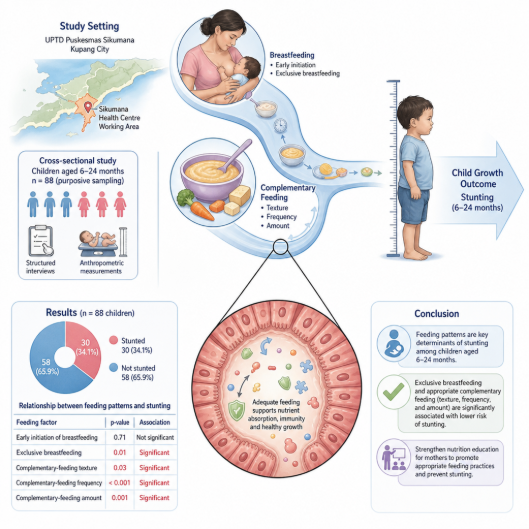
Background: The alarmingly high stunting prevalence of 26.6% in the Sikumana Health Centre area, which significantly exceeds the Kupang City average, creates an urgent need to investigate suboptimal feeding practices encompassing early initiation of breastfeeding (EIBF), exclusive breastfeeding, and complementary feeding (MP-ASI) as the primary suspected drivers of this local nutritional crisis. This study aims to determine the relationship between feeding patterns and the incidence of stunting among children aged 6–24 months in the working area of UPTD Puskesmas Sikumana, Kupang City. Methods: This was a quantitative observational analytic study with a cross-sectional design. A total of 88 children aged 6–24 months were selected using purposive sampling. Data were collected through structured interviews and anthropometric measurements, then analyzed using the chi-square test. Results: Of 88 children, 30 (34.1%) were stunted. No significant relationship was found between EIBF and stunting (p=0.71). Significant relationships were found between exclusive breastfeeding (p=0.01), complementary-feeding texture (p=0.03), frequency (p < 0.001), and amount (p=0.001) and stunting. Conclusion: Feeding patterns, particularly exclusive breastfeeding and the appropriateness of complementary-feeding texture, frequency, and amount, are significantly associated with the incidence of stunting among children in the Sikumana Health Centre working area. Nutrition education for mothers of young children regarding appropriate feeding practices should be strengthened as a stunting prevention effort.
Downloads
Published
How to Cite
Issue
Section
License
Copyright (c) 2026 Honi Benoni Tamonob, Astuti Nur

This work is licensed under a Creative Commons Attribution-NonCommercial-ShareAlike 4.0 International License.